|
As of 2015, the PTIDES Project has ended. We have successfully
demonstrated that a timed, deterministic model for distributed
cyber-physical systems is practical and realizable. The model leverages
clock synchronization, which is slowly becoming ubiquitous. Access by
application software to high-precision synchronized clocks will soon be
routinely available, making the PTIDES programming model a natural one
for distributed systems where predictable and controllable performance
is necessary. The PTIDES model has been deployed for distributed
databases in Google Spanner (where it was apparently independently
reinvented in 2012). It is even more suited, however, to cyber-physical
applications such as industrial automation, automotive, avionics, and
energy systems. We now pass the baton to those industries to take up
this technology.
Timing-Centric Software
See a short introductory video on PTIDES
This project focuses on model-based design principles for event-triggered real-time
distributed systems. We are interested in cyber-physical applications with one or more of the
following characteristics:
- Highly asynchronous stimulus response such that the periodic sampling used in safety-critical systems is not a feasible solution,
- Mixed systems where periodic sampling and asynchronous stimulus response are both present,
- Systems where knowing the precise time (at a fine grain than possible using periodic sampling) is required, and
- Systems where the order of distributed events must be determined to high accuracy and this order preserved in any response.
The project is developing a programming model called PTIDES
(for Programming Temporally Integrated Distributed Embedded Systems)
and an associated software toolchain.
The motivating applications are drawn from the domain of electro-mechanical
(as illustrated by some test applications: Printing Press,
Tunneling Ball Device)
and energy
(Power Plant,
Synchrophasor) systems.
Objectives
- Design and deployment of PTIDES programming model and its integration with network models and models of physical dynamics,
- Design of a low-footprint distributed operating system that realizes this programming model, and
- Development of program analysis techniques that check system implementations for satisfaction of PTIDES temporal semantics.
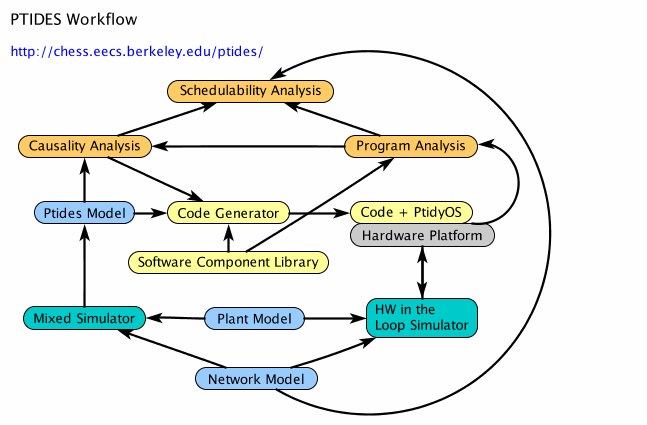
Click the items in the following figure for descriptions.
Publications (in reverse chronological order)
- Edward A. Lee, "What Is Real Time Computing? A Personal View," to appear in IEEE Design & Test, 2017.
- John C. Eidson, Kevin B. Stanton, Timing in cyber-physical systems: The last inch problem, in IEEE Proceedings of International Symposium on Precision Clock Synchronization for Measurement, Control, and Communications (ISPCS)
, pp. 19-24, Oct. 11-16, 2015, Beijing, China.
- Edward A. Lee, "The Past, Present, and Future of Cyber-Physical Systems: A Focus on Models," Sensors, 15(3), pp. 4837-4869, doi:10.3390/s150304837, February, 2015.
-
Janette Cardoso, Patricia Derler, John C. Eidson, Edward A. Lee, Slobodan Matic, Yang Zhao, and Jia Zou.
Modeling Timed Systems.
Chapter in Claudius Ptolemaeus, ed., System Design, Modeling, and Simulation using Ptolemy II, Ptolemy.org, 2014.
-
Jia Zou, Slobodan Matic and Edward A. Lee.
PtidyOS: A Lightweight Microkernel for Ptides Real-Time Systems.
Proceedings of IEEE Real-Time and Embedded Technology and Applications Symposium (RTAS), 2012, April, 2012.
-
John Eidson, Edward A. Lee, Slobodan Matic, Sanjit A. Seshia and Jia Zou.
Distributed Real-Time Software for Cyber-Physical Systems.
In Proceedings of the IEEE, January, 2012.
-
Jia Zou, From Ptides to PtidyOS, Designing Distributed Real-Time Embedded Systems, Ph.D. Dissertation, EECS Department, University of California, Berkeley, Technical Report No. UCB/EECS-2011-53, May 13, 2011.
-
Patricia Derler, John C. Eidson, Edward A. Lee, Slobodan Matic and Michael Zimmer.
Model-Based Development of Deterministic, Event-Driven, Real-Time Distributed Systems. International Workshop on Model-Based Design with a Focus on Extra-Functional Properties (MBDEFP), 2011.
-
Slobodan Matic, Ilge Akkaya, Michael Zimmer, John C. Eidson and Edward A. Lee.
PTIDES Model on a Distributed Testbed Emulating Smart Grid Real-Time Applications.
In Proceedings of the IEEE Conference on Innovative Smart Grid Technologies (ISGT-EUROPE), 2011.
-
Jeff C. Jensen, Danica Chang and Edward A. Lee.
A Model-Based Design Methodology for Cyber-Physical Systems.
In Proceedings of the IEEE Workshop on Design, Modeling, and Evaluation of Cyber-Physical Systems (CY-PHY), 2011.
-
John C. Eidson, Edward A. Lee, Slobodan Matic, Sanjit A. Seshia and Jia Zou,
Time-centric Models For Designing Embedded Cyber-physical Systems, Technical Report No. UCB/EECS-2009-135, EECS Department University of California, Berkeley.
Also in Proceedings of the Third International Workshop on Model-Based Architecting and Construction of Embedded Systems (ACES-MB), 2010.
-
Jia Zou, Joshua Auerbach, David F. Bacon and Edward A. Lee.
PTIDES on Flexible Task Graph: Real-Time Embedded System Building from Theory to Practice.
In Proceedings of the ACM Conference on Languages, Compilers, and Tools for Embedded Systems (LCTES), 2009.
-
Jia Zou, Slobodan Matic, Edward A. Lee, Thomas H. Feng and Patricia Derler.
Execution Strategies for PTIDES, a Programming Model for Distributed Embedded Systems.
In Proceedings of the IEEE Real-Time and Embedded Technology and Applications Symposium (RTAS), 2009.
-
Yang Zhao,
On the Design of Concurrent, Distributed Real-Time Systems, Ph.D. Thesis, Technical Report No. UCB/EECS-2009-117, EECS Department,
University of California, Berkeley, August 13, 2009.
-
Thomas Huining Feng, Edward A. Lee, Hiren D. Patel, and Jia Zou,
Toward an Effective Execution Policy for Distributed Real-Time Embedded Systems, in Proceedings of the IEEE Real-Time and Embedded Technology and Applications Symposium (RTAS), Work-in-Progress Session, St. Louis, MO, USA, Apr 2008.
-
Patricia Derler, Edward A. Lee and Slobodan Matic.
Simulation and Implementation of the PTIDES Programming Model.
In Proceedings of the IEEE International Symposium on Distributed Simulation and Real Time Applications (DS-RT), 2008.
-
Thomas H. Feng and Edward A. Lee.
Real-Time Distributed Discrete-Event Execution with Fault Tolerance.
In Proceedings of the IEEE Real-Time and Embedded Technology and Applications Symposium (RTAS), 2008.
-
Yang Zhao, Jie Liu and Edward A. Lee.
A Programming Model for Time-Synchronized Distributed Real-Time Systems.
In Proceedings of the IEEE Real Time and Embedded Technology and Applications Symposium (RTAS), 2007.
Internal Version.
Mailing lists and discussion forums may be found under the ptides link above.
Acknowledgments
The primary funding for this project is from the National Science Foundation
under award #1035672 (CPS: Medium: Timing-Centric Software).
Contributions are also made by projects
supported in the Center for Hybrid and Embedded
Software Systems (CHESS) at UC Berkeley, which receives support from
the National Science Foundation (NSF awards #0720882 (CSR-EHS: PRET),
#0931843 (CPS: Large: ActionWebs), and #1035672 (CPS: Medium: Ptides)),
the U. S. Army Research Laboratory (ARL #W911NF-11-2-0038), the Air
Force Research Lab (AFRL), the Multiscale Systems Center (MuSyC), one
of six research centers funded under the Focus Center Research
Program, a Semiconductor Research Corporation program, and the
following companies: Bosch, National Instruments, Thales, and Toyota.
|

